
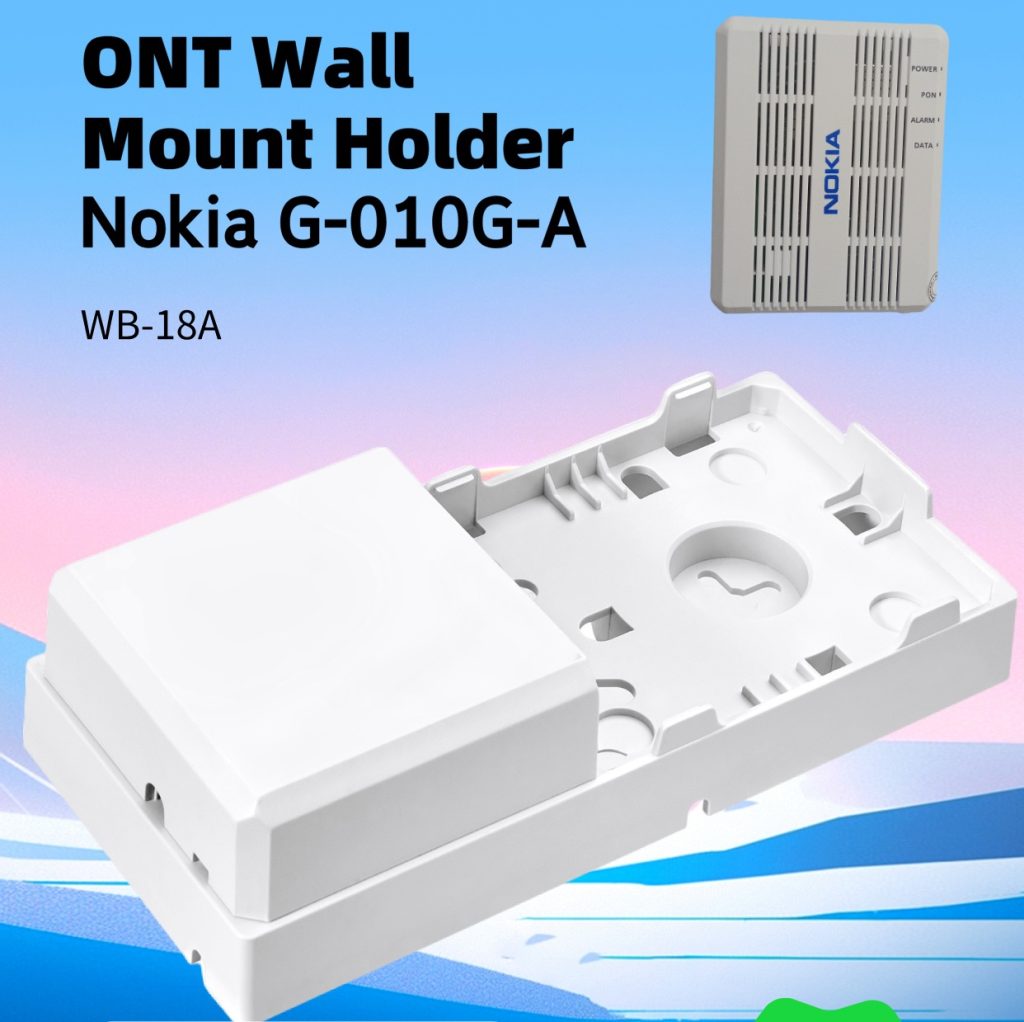
In the rapidly evolving world of fiber optic broadband deployment, network reliability is paramount. One of the most persistent yet critical challenges for field technicians is maintaining the minimum bending radius of the fiber optic cable. Excessive bending can lead to macrobending or microbending losses, causing signal attenuation, performance degradation, and increased failure rates. This not only impacts customer experience but also drives up operational costs for ISPs through truck rolls and repairs. The solution lies not just in careful handling, but in intelligent hardware design that enforces proper fiber routing from the point of installation. This is where a well-designed Wall-Mount ONT Bracket with integrated organizer clips becomes a game-changer.
The Critical Role of the Bending Radius
Optical fibers transmit data as pulses of light. When a fiber is bent too sharply, light can escape the core, leading to signal loss. Each fiber type has a specified minimum bend radius (e.g., 10-20 times the cable diameter for long-term installation). During and after installation, fibers are vulnerable at key points: the drop cable entry, the slack loop or storage area, and the connection ports on the Optical Network Terminal (ONT). Traditional methods rely heavily on the installer’s skill and ad-hoc solutions like tape or loose tie-wraps, which are inconsistent and can shift over time.
How Built-in Organizer Clips Act as a Permanent Guardian
This is where the engineered design of a dedicated bracket shines. Built-in organizer clips and routing channels are not mere accessories; they are a proactive protection system. Here’s how they work:
- Guided Routing: The bracket features predefined, smooth routing paths from the entry point to the ONT mounting location. The clips guide the fiber along a safe trajectory, physically preventing the technician from creating sharp bends even if they try to force a shorter path.
- Slack Management: A crucial section of any installation is the service loop or slack storage. Integrated clips and spools allow the excess fiber to be coiled in a consistent, large-diameter loop. This organized storage protects the bend radius and makes future servicing (like re-terminating a connector) straightforward without stressing the live fiber.
- Strain Relief at Entry Points: The cable entry point is a common failure location. Organizer clips near the entry secure the cable jacket, preventing push/pull forces from being transferred to the delicate fiber bend inside, thus eliminating a point of acute stress.
- Separation and Organization: Multiple fibers (e.g., the drop fiber and a patch cord to the ONT) can be neatly separated and secured. This prevents tangling and accidental pinching or crushing that could occur when cables are left loose behind the ONT.
Transforming Field Operations for ISP Technicians
For the ISP installation team, this intelligent hardware translates directly into efficiency, reliability, and cost savings.
- Simplified Installation: The bracket acts as an intuitive guide. Technicians spend less time figuring out how to secure the fiber neatly and correctly. The “right way” becomes the “easy way,” reducing installation time and cognitive load.
- Elimination of Human Error: It enforces best practices. Even on a long day, the design ensures every install meets the same high standard for fiber protection, reducing variability and installation-related defects.
- Enhanced Aesthetics & Customer Confidence: A clean, professional-looking install with no loose, tangled wires inspires customer confidence in the network’s quality and the ISP’s professionalism.
- Long-Term Network Integrity: By safeguarding the fiber from day one, the bracket drastically reduces the risk of future “slow speed” complaints or outages caused by creeping bend-induced losses. This improves Mean Time Between Failures (MTBF) for the access network segment.
Conclusion
Protecting the fiber bending radius is a non-negotiable requirement for a robust FTTH network. Relying on manual technique alone is an operational risk. A purpose-built Wall-Mount ONT Bracket with integrated fiber organizer clips provides an elegant, passive engineering solution. It physically enforces proper fiber handling, simplifies the technician’s job, and ensures the installed base maintains its optical performance for years to come. For ISPs focused on quality, scalability, and lowering total cost of ownership, investing in such optimized installation hardware is a strategic move towards a more reliable and efficient fiber network.